Own Product
Umrah Platform
A configuration-driven website platform for Hajj and Umrah agencies. New branded sites are generated from one maintainable codebase using structured content and per-agency configuration.
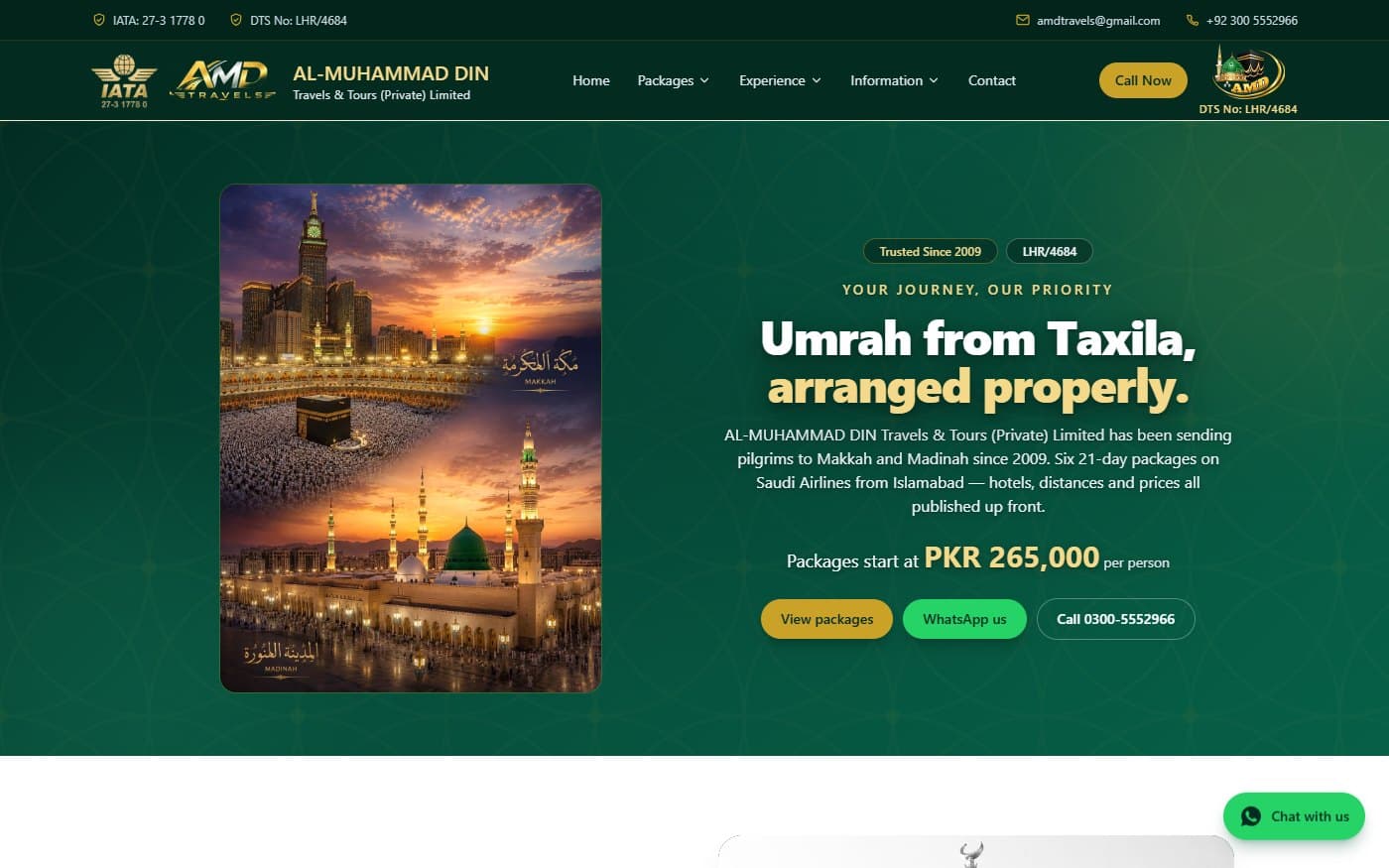
Verified outcome
- First paying client site delivered and live — www.amdtravels.com
- 11 statically generated pages per agency site
The problem
Hajj and Umrah agencies need a credible public website that lists packages, prices, hotels, flights, and inclusions accurately — and keeps them current through a season. Building each site from scratch means repeating the same structure for every agency and maintaining a separate codebase per client.
What I built
One Next.js codebase where an agency is a typed configuration file rather than a fork. The configuration carries packages, prices, flight details, hotel distances, inclusions and exclusions, contact routes, legal pages, and branding; the same components render any agency from it. Sites are statically generated, so each one serves as plain HTML at the edge.
Key features
- Typed per-agency configuration covering packages, pricing, flights, hotels, inclusions and exclusions
- Package pages with duration, airline, departure city, and Makkah/Madinah hotel distances
- Contact routing, including WhatsApp, mapped per agency
- Generated legal pages — privacy policy, terms, refund policy
- Per-agency branding and metadata
- Static generation for every page
Architecture and technical decisions4 notes
- Content model is a typed TypeScript configuration rather than a CMS, so a malformed agency fails at build time instead of in production.
- Every page is statically generated — 11 pages per site — which keeps hosting simple and response times flat.
- Apex-to-www is handled by a host-condition redirect compiled into the edge routing table, so it costs no function invocation. The pattern is anchored, because an unanchored one would match www and redirect it to itself indefinitely.
- Images run through sharp at build time.
Stack
Next case study
BaraKat ERP